Wednesday, July 10, 2013

The Great Malaysian Robbery

The Great Malaysian Robbery

May 7, 2013

FMT LETTER: From Erik M Gan, via e-mail
As the dust settles in the aftermath of the elections, many citizens are asking themselves the same question, “Where do we go from here?” This is the burning inquiry among my fellow Malaysians as we struggle to swallow the results of GE13. I guess in some ways you could say that we were cautiously prepared for this outcome, it was a dread that built up at the back of our throats but we never expected the results to be marred by such blatant fraud. Put it down to being a little green around the ears but I for one chose to believe in the democracy previously promised to us and enshrined in the constitution. I still believe that real democracy lies in the hands of the rakyat, what I’ve completely lost faith in are the structures that govern that democracy.
The injustice has been documented and laid bare in the public sphere for all to see -the phantom voters, the mass blackouts, the mysterious ballot boxes escorted to constituencies where the vote was on a knife’s edge. Coupled with the gerrymandering that has become endemic in the Malaysian electoral process, it almost seems that the Pakatan cause was lost from the word go. Barisan Nasional has even said that the results of the polls should be accepted and that the Election Committee was spotless. Grace in defeat is a value I’ve always believed in but I refuse to accept defeat when the rules that apply to the competition are constantly altered to skew towards the ruling coalition.
It is my personal opinion that we’ve witnessed the greatest robbery in Malaysian history and we now have the unenviable tag of being one of the world’s dirtiest “democracies”. Just to add insult to injury, Najib Tun Razak had the nerve to suggest that Barisan Nasional’s poorer than expected showing in the elections was down to a “Chinese Tsunami” He insults the intelligence of Malaysians who know for a fact that despite his coalition’s most concerted efforts, Pakatan Rakyat secured more than 51% of the popular vote and that ethnic Chinese make up only 24.6% of the Malaysian population. Perhaps more offensive than that, his bafflingly thoughtless statement suggests that the Chinese community has polarised voting trends and their alignment towards the opposition would be dangerous for the country.
What he fails to comprehend is that the results of the elections indicate not an ethic swing, but rather a national one especially evident in the more urban constituencies. It would be wickedly ironic if it were not so tragic, but Najib goes against the very principles of unity his gaudy 1Malaysia adverts extol when he suggests that the Chinese community is splitting this country apart. You sir, are completely out of line and you insult not only me, but also my Malay and Indian friends who have stood united under PKR, DAP and PAS flags over the past five years. Your coalition does not represent all Malaysians equally and you, Mr. Prime Minister, certainly do not represent me.
Where do we find silver linings as the clouds of ash settle around us?  For starters, we must be encouraged that 51% of Malaysians at least have some form of common sense and dignity. We must also be heartened that Malaysians came out in droves to cast their ballots in what was the highest ever turnout of voters – 13,268,002 voters for the 222 parliamentary seats with 11,257,147 voters or 84.84% casting their votes. At this juncture in time it is important that we channel our anger and disappointment into tangible plans of action. The sense of euphoric hope that was built up over the past few months has undoubtedly been dampened but we have to make doubly sure that it is not extinguished. It is easy to go into hiding after we’ve been knocked back but we can draw strength from the words of Theodore Roosevelt, “It is hard to fail, but it is worse never to have tried to succeed”.
“What happens now?” I remember asking my Malay friend over the phone as I stared numbly at the final tally on my laptop in the early hours of Monday morning. “What happens now is that tomorrow we fill in and submit our membership forms for Keadilan” he replied without skipping a beat. It is this inextinguishable fighting spirit that will keep us going and as far as I can see, I’m not the only one who shares this sentiment. In the wake of the general elections I’ve witnessed Malaysians coming together to initiate grassroots demonstrations – be it in the form of blackout protests, online petitions or student movements. What’s important is that we do not allow the spirit of Reformasi to die, we must keep the flame burning bright and we must stoke the embers in those who still choose to remain passive. If you choose to remain neutral in times of great injustice then you have already chosen the side of the oppressor.
What’s equally important is that we throw all our efforts in albeit in a peaceful, thoughtful manner. Violence only begets violence and if we claim to be better than our opponents then we must also be careful not to stoop to their level. I’ve witnessed the xenophobic witch-hunts targeting foreign workers over the past few days and I appeal to your better senses not to allow this cycle of intolerance to continue. After all, how can we claim to be for equality when we do not practice what we preach? Let morality be your guide and ensure that your longing for justice does not cloud your judgement. If there’s anything I’ve learnt over the past few days, it is that we have emerged steelier and more united than before. The time for licking our wounds has passed, the time for us to stand up and be counted has come. All I’ve ever been relatively decent at is writing and this is my contribution. What will yours be? Lawan tetap lawan.
“Injustice in the end produces independence” - Voltaire
The writer is a final year Writing student from Monash University
http://www.freemalaysiatoday.com/category/opinion/2013/05/07/the-great-malaysian-robbery/


Honesty needed in tackling crime, police abuse

Honesty needed in tackling crime, police abuse

July 11, 2013
NEWS ANALYSIS - Without honesty, it is impossible to tackle Malaysia's crime or corruption problem. Or even improve the sullied image of the police force. Impossible.
Double-speak, shading the truth or plain lies may win legislators, politicians and enforcement agencies some breathing space and positive headlines in the discredited mainstream media. But it does little to win over the majority of Malaysians who come face to face with crime and graft daily.
So how about starting over again? Has crime in Malaysia gone down or is it climbing steadily? Note to Home Minister Datuk Seri Ahmad Zahid Hamidi: you cannot have it both ways.
In Parliament a few days ago, Zahid said that the increase in the crime index recently was due to the abolition of the Emergency Ordinance (EO), legislation which allowed the government to detain gangsters and hardened criminals without trial.
But as DAP's Tony Pua pointed out, the crime index was the highest in 2008 and 2009 when the EO was still in effect but supposedly fell by 76 per cent last year after the Najib administration repealed the law.
In short, there does not appear to be a direct link between abolishing the EO and rising crime as alleged by Zahid and the police.
If few believe statistics trotted out by Zahid and his ilk it is because skeptical Malaysians have been fed a diet of highly fanciful figures on crime by the Performance Management and Delivery Unit led by Minister in the Prime Minister's Department Datuk Seri Idris Jala.
Two years before the elections, Malaysians were told that crime had dropped drastically, and now suddenly there is a surge in crime. This neat packaging of facts fits snugly with the government's narrative that the abolition of the EO has resulted in the increase in crime. Never mind the gaping hole in this yarn.
Similarly, there is a lack of honesty in the debate about the Independent Police Complaints and Misconduct Commission (IPCMC), the body recommended by the Royal Commission to Enhance the Operation and Management of the Royal Malaysia Police that was set up in 2004.
The only reason the weak Abdullah administration were unwilling to set up the commission was because it feared backlash from the police force.
The then Prime Minister Tun Abdullah Ahmad Badawi wanted to improve the image of the police force but did not have the political will to take on and defeat special interest groups within the police - groups which warned the government that the IPCMC would result in sagging morale of police personnel.
Never mind what the country or Malaysians wanted. Abdullah backed off and the IPCMC proposal collected dust.
What came out of it was the very much diluted Enforcement Agency Integrity Commission (EAIC) that was eventually only staffed by one investigator.
Now, complaints and custodial deaths remain on the rise as much as crime does, and the police say the only way is to have laws that keep bad hats off the streets.
But what about the IPCMC? There is talk now that it is unconstitutional but that was not the reason to reject it when it was mooted by the commission headed by the former Chief Justice of Malaysia, Tun Mohamed Dzaiddin Abdullah.
Wouldn't he know what was proposed and recommended is within the ambit of the law? It would appear that some government leaders are just clutching at straws to justify rejecting the IPCMC.
Both reflect the dishonesty in the country, at the expense of the very people that the government says it cares for and defends in the marathon to a developed nation by 2020. - July 11, 2013.

http://www.themalaysianinsider.com/malaysia/article/honesty-needed-in-tackling-crime-police-abuse/


Thursday, June 27, 2013

Sime Darby and 2 other companies rebut haze claims

Sime Darby and 2 other companies rebut haze claims


JUNE 24, 2013
Three companies -- Asia Pacific Resources International (APRIL), Asia Pulp and Paper (APP), and Sime Darby -- have issued rebuttals after being named by Indonesia's Senior Presidential Aide Kuntoro Mangkusubroto as being among several responsible for fire hotspots in Riau Province.
In a statement released to the media, Asia Pacific Resources International Limited (APRIL) said Indonesia's accusation requires verification.
"They do not correspond with intensive monitoring on-the-ground conducted by APRIL in its own concessions over the past several weeks nor with information on Friday from Indonesia's official national body for Meteorology, Climate and Geophysiccs, which identified 13 hotspots in Riau, none of which are on APRIL's concessions," APRIL said in a statement.
The company said the Director General of the Ministry of Forestry, Bambang Hendroyono, had confirmed Friday the fires causing the haze were mostly occurring on community land, not forestry concessions.
APRIL said it had maintained a "strict no-burn policy in its concessions" since it began operations in 1994, reported CNA.
It added the small number of fires within its concessions over the past three weeks were spread from those that began outside its concessions and were extinguished by its fire fighting teams.
Asia Pulp and Paper (APP) also said it does not practise, and "highly condemns" the slash and burn activity for its detrimental impact on the environment.
The company said it is deeply concerned about the forest fires and resulting haze in Riau, Sumatra, and is urging others to support it in implementing "zero burning and zero deforestation practices".
APP said its fire fighting crews and community members have been working to control the fires in its suppliers' concessions.
"The task is very complex because of the combination between strong wind, high temperature and the fact that the fire has reached peat land," APP said in its statement.
APP added that it welcomes opportunities to work with NGOs, companies, communities and governments to address the haze problem.
Malaysian plantation giant Sime Darby, which runs PT Tunggal Mitra, has also denied reports of any fires on its property.
Sime Darby Plantation said there were no fires in any of its operating areas in Indonesia, and that it strictly adheres to a zero burning policy in its operations.
Tunggal Mitra Plantation covers almost 14-thousand hectares, the majority of which is used for planting and development.
Sime Darby said there are some parts occupied by local communities, and that it is unable to exert control over those areas. -  June 24, 2013.

Monday, June 17, 2013

Najib: Opposition is teaching people 'bad things'

Friday, 06 July 2012 17:10

Najib: Opposition is teaching people 'bad things'      

    Prime Minister Datuk Seri Najib Tun Razak said today opposition political parties in the country seem to be teaching people bad things, even matters contrary to religion.

Evidently, three bad things were that debts do not have to be settled, good deeds can be forgotten and promises need not be fulfilled, he said.

"Many promises were made (by the opposition parties) during the last general election but (after coming to power in several states) they did not fulfill them," he said at the presentation of Aidilfitri clothing to 45 non-governmental organisations and 52 boat motors to fishermen in his Pekan parliamentary constituency, here.
Najib said the Barisan Nasional (BN) government, on the other hand, not only fulfilled its promises but also provided the people with aid which it had not promised in the first place.
He also said that Islam required all debts to be settled, and added that when people died, their outstanding debts had to be settled by their next-of-kin.
By debts, the prime minister was apparently referring to those associated with the opposition proposal to write off the loans provided by the National Higher Education Corporation Fund (PTPTN).
No need to remember BN's good deeds
Najib said the opposition was also poisoning the minds of the people by suggesting that they did not have to appreciate what the government was doing for them.
"They tell people it is not necessary to remember good deeds, associated with aid for the people. I do not know of any country providing the people with mosquito nets, dentures and spectacles. When the government resurfaces a road, tarring is done up to the steps of houses," he said.
Najib said what the country has achieved so far would not have been garnered without having national leaders with integrity and vision.
"Without integrity and vision, implementing any plan would result in a nightmare for the people," he said.
The prime minister said the people should be grateful for the peace and unity they enjoyed.
"Let's not make a mistake. If we do, we will lose the blessings we now enjoy. We have seen what has happened to the people in countries where political stability has been compromised," he said.
Najib's wife, Datin Seri Rosmah Mansor, was also present at the event.
-- BERNAMA

http://www.malaysia-chronicle.com/index.php?option=com_k2&view=item&id=36047:najib-opposition-is-teaching-people-bad-things&Itemid=2

Penang UMNO building collapse. Antenna breaks by strong wind.

Penang UMNO building collapse. Antenna breaks by strong wind. 
http://www.youtube.com/watch?feature=player_embedded&v=iTl4xJ7Q8lg

Penang Disaster! Wind Blows UMNO Building Roof Collapse / Break Off
 http://www.youtube.com/watch?feature=player_embedded&v=jegDIwMqUC4


Star

Published: Friday June 14, 2013 MYT 8:15:00 PM
Updated: Friday June 14, 2013 MYT 11:03:39 PM

Penang freak storm: Work starts on removing “hanging beam”

By CAVINA LIM
The beam on top of the Umno building The beam on top of the Umno building
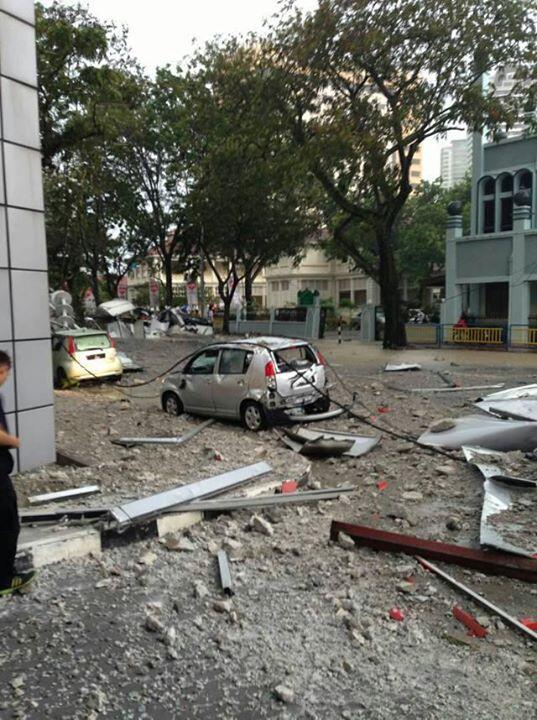
GEORGE TOWN: A crane is being used to remove a concrete beam that is hanging precariously at the Umno building in Macalister Road here.
The beam fell on top of the 21-storey state Umno headquarters during Thursday’s thunderstorm which blew a section of a lightning arrestor and crashing onto the road.
Chief Minister Lim Guan Eng said Friday that a giant crane would be used to remove the 20-foot concrete beam and work could only start tomorrow.
He said the crane only arrived at the scene at 7pm and by the time it is assembled and ready to work it would be late night.
“It takes about at least three hours to set up the whole crane,” he said when met at the scene in Macalister Road.
However, the authorities said work to remove the beam would be carried out throughout the night.


紧急,快快share出去!!!
巫统大厦楼牌已倾斜约15度,情况骇人,促请民众勿接近灾区,以避免不幸事件的发生

Emergency, quickly share out!!! UMNO building is tilted about 15 degrees, shocking, urged people not to close to the disaster area in order to avoid unfortunate events happen! (Translated by Bing)
a
—–
UMNO HQ LOSES LIGHTNING ROD, NOT ANTENNA.
a
The massive gale which started around 6.55pm tore off the lightning rod of the state Umno building in Jalan Macalister.
Earlier reports had referred to the lightning rod as an aerial, but the Malaysian Communications and Multimedia Commission later clarified that it was a lightning rod.
The 20-metre lighting arrestor atop the Umno building in Jalan Macalister collapsed, leaving one person dead and eight others injured.
Jahir Hussain Sulaiman, 46, the driver of a pick up truck who was seriously injured in the incident later died at the Penang Hospital.
His nephew Azharudeen Mohd Mohideen, 18, told reporters at the hospital’s mortuary at 11.30pm that his uncle had died.
The lighting arrestor had collapsed on his vehicle and six other vehicles that were parked below. The rest of the victims only sustained minor injuries.
Penang police chief Abdul Rahim Hanafi said the storm caused the the 20-metre lighting arrestor atop the Umno building in Jalan Macalister to collapse at around 6.45pm and damaged seven vehicles including the pick up truck.
He said the driver of the pick up truck had been seriously injured.
https://www.freemalaysiatoday.com/category/nation/2013/06/14/storm-wreaks-havoc-in-penang/
—–
Malaysiakini
Compensate lightning rod crash victims, Umno told
Penang PAS wants Umno to compensate the people injured and owners of vehicles that were damaged in the massive storm that hit George Town yesterday and caused a huge lightning rod to fall off the top of the Penang Umno headquarters on Jalan Macalister.
Earlier reports had referred to the lightning road as an aerial, but the Malaysian Communications and Multimedia Commission later clarified that it was a lightning rod.
The incident caused the death of one person, injured five others, with the strong winds wrecking havoc in the other parts of Penang as well. Another person died in Air Itam, after being hit by a falling tree.
NONEState PAS Youth secretary Afnan Taib Azimudden (right) said Umno leaders should not just be praying that no one was injured.
Afnan was referring to a Malaysiakini report last night quoting state Umno Youth chief Shaik Hussein Mydin as expressing sympathy to those affected by the incident.
Compensate lightning rod crash victims, Umno told
—–
23h
Salah taip yg betul lentur ibupej umno yg sebelum ini tegak-Menara Ibupej UMNO Pg yg luntur skrg akibat ribut kencang
—–
a
—–

—–
Malaysiakini

Penang gov’t to give aid to victims of storm
The Penang government would be giving financial assistance to the victims of the storm which wreaked havoc in several parts of the island and mainland, causing two deaths and several injured last night.
Chief Minister Lim Guan Eng said his administration was assessing the situation and would also give aid to those whose rooftops were blown away by the strong winds.
NONE“We feel regret and express our deepest sympathies to those affected and hope they or their families can be patient while we sort things out,” Lim said at a press conference along Jalan Macalister.
“For those whose rooftops have been blown away, we urge them to lodge a police report. Our welfare department is also assessing the situation,” he added.
Penang gov’t to give aid to victims of storm
—–
Malaysiakini

The Penang Umno headquarters was damaged by strong winds, breaking the antenna from the 23-storey building.
NONEAccording to Bernama, seven pedestrians were injured. Two of whom suffered serious injuries. Seven vehicles were also damaged.
The Lebuh Pantai fire station said that the incident happened at 6.55pm.
a
The rubble had caused massive damage to Jalan Macalister, located in the heart of Georgetown.
…..
In a press release, Penang Chief Minister Lim Guan Eng urged Penang Umno officials to swiftly provide rescue workers access to the roof to prevent more debris from falling off the roof.
“About seven cars have been damaged and we hope there are no more casualties,” he said.
When contacted, Penang State Umno Youth chief Shaik Hussein Mydin said he received word that the lighting rod of the building has collapsed.
“It’s an accident, a natural disaster. We hope no one is hurt, ” he said.

—–


—–


—–
23h
Struktur bangunan umno runtuh..
—–
Star

Published: Thursday June 13, 2013 MYT 8:19:00 PM
Updated: Thursday June 13, 2013 MYT 11:11:19 PM

Storm blows antenna tower off roof top, causes gridlock on major roads in Penang (Updated)

By CAVINA LIM
Fire personnel carrying out investigations on the road where the antenna fell Fire personnel carrying out investigations on the road where the antenna fell
GEORGE TOWN: A thunderstorm blew havoc in Penang uprooting trees and causing gridlock on major roads here on Thursday.
The strong winds, which started at 7pm, blew off a 40m section of a pole located on top of the 21-storey Menara Umno in Macalister Road.
Some of the damaged cars after a section of a pole fell after the storm Some of the damaged cars after a section of a pole fell after the storm
Trees were also uprooted in several places, falling on parked cars.
In Tanjong Tokong, roof awnings was seen flying off from houses.
Five people including two seriously injured were sent to the hospital.
Welfare, Caring Society and Environment Committee chairman Phee Boon Poh said a man, who was walking up the Air Itam Dam during the storm, died after suffering a heart attack when a falling tree narrowly missed him.
The Meteorological Department said the storm lasted for about one hour from 7pm.

Wednesday, May 29, 2013

The Climatic Origins of the Malaysian Nipah Virus Outbreak

The Climatic Origins of the Malaysian Nipah Virus Outbreak

By Rebecca Kreston | April 30, 2013 12:30 pm
One of the hardest questions to answer in an infectious disease outbreak investigation is “Why?”
Why then? Why there? These questions can be almost impossible to answer – not only because of their heady metaphysical nature but also because of the difficulty of assessing the minute interactions between microbe, environment and human host. Public health officials are often left shrugging their shoulders, half-heartedly admitting to an unsatisfied public that they just don’t know and indeed may never know, later drowning their sorrows in dark and smoky bars with cup after cup of the metabolic waste products of unicellular fungi.
An epidemiologist decked out in personal protective equipment (PPE) while conducting field work on the Nipah virus outbreak in Malaysia. Source: CDC, Public Health Image Library.
In the final scene of the Contagion, a film that depicts the rapid spread around the world of a (bogus) fatal respiratory pathogen called MEV-1, director Steven Soderbergh elegantly demonstrates the why and how of the origins of the fictional viral pandemic. Behold:
In some exotic tropical locale, a bulldozer ravages a grove of palm trees, dislodging a cloud of angry bats that flee to a nearby stand of banana trees for shelter. One bat carries a precious cargo of half-eaten, saliva-covered banana to what appears to be a pig farm, dropping its partially-consumed treasure to the ground, where it is quickly spotted and devoured by a keen-eyed piglet. That pig is selected and transported to the kitchen of a Macau casino, where it lies dead and trussed as it awaits the final stage of  its culinary preparation. A chef is shown squishing herbs into its mouth before he’s distracted by a kitchen lackey. Wiping his hands on his apron, he leaves the kitchen to shake hands with Gwenyth Paltrow’s character, our index patient, thereby initiating the global journey of MEV-1.
In this brief narrative montage, the origins of the MEV-1 pandemic are laid bare, simple and orderly with chilling background music for the audience’s pleasure to boot. How tidy! Perhaps a little too tidy…
The scenario depicted at the end of Contagion, while certainly plausible, is in most cases virtually impossible for public health researchers to reconstruct. To wit, while we are often able to reach general conclusions as to the origins of an outbreak, it is rare for such a clear chain of events to emerge. But the outbreak depicted in the film is loosely based upon the 1998-1999 emergence of Nipah virus in Malaysia, the same virus that introduced itself to the world by erupting into a massive outbreak among pig farmers and abattoir workers in Malaysia. As in Contagion, there, too, was a tipping point, a series of spillover events closely tied to human manipulation of the environment that led to one of the most frightening and costly outbreaks in recent history.
1997 and 1998 were ugly, hazy years for Malaysia. Massive swaths of tropical rainforest in Indonesia were slash-and-burned for industrial plantation and pulpwood, resulting in an impenetrable haze that cloaked the peninsula and the surrounding Southeast Asian countries for months. 12 million acres of rainforest were deforested and the haze so obscured the sunlight in southern Malaysia that flowering and fruiting trees could not photosynthesize. Crops failed throughout the country (1).
This image from NASA’s Earth Probe Total Ozone Mapping Spectrometer (TOMS) satellite instrument shows the extent of the air pollution resulting from the Indonesian forest fires in fall of 1997. White smoke hovers over southeast Asia, while the green, yellow and red pixelation indicates ozone or smog. Source: NASA/GSFC Scientific Visualization Studio, based on data from TOMS.
At the same time, a drought precipitated by the El Niño Southern Oscillation (ENSO) event didn’t help the ecological and environmental status quo.
Cases of an unusual febrile encephalitis falling both human and swine began in the fall of 1998 among the pig farming communities of the northwest Malaysian district of Kinta. With each pig exported from Kinta to the districts of Negeri Sembilan, Sungai Nipah and Bukit Pelanduk, more and more farms were stricken by an illness that was initially mistakenly identified as Japanese encephalitis, a disease spread by mosquitos (2).
While government workers provided vaccinations and mosquito fogging, pigs exported to Singapore for slaughter infected eleven abattoir workers on that tiny island, one man died, and the international impact of the disease continued to expand. This was no mosquito-borne illness but something quite different, though the truth of just what the disease was and how it was spreading would elude Malaysian authorities for months.
Meanwhile, the ethnic Chinese minority that largely work as pig farm owners and abattoir workers in the country were ostracized (3). Pig exports crashed. The pig industry – one of the largest in southeast Asia – shut down temporarily and more than US$100 million in revenue was lost (4). Finally, upon the discovery of a novel virus identified as spreading from pigs to humans, the Malaysian government destroyed 1.1 million pigs destroyed at a cost of US$3.5 million (4). Approximately 265 people fell ill and 105 died (5).
Once Nipah virus was detected in fruit bats such as the Malaysian flying fox (Pteropus vampyrus) and the Island flying fox (Pteropus hypomelanus), researchers at the College of Kuala Lumpur in Malaysia began to suspect that “anthropogenic events” may have been responsible for this dreadfully fatal and expensive outbreak. The cataclysmic combination of the haze, deforestation and drought devastated the foraging habitats of the bats, prompting a widespread migration (1). Seeking sustenance and refuge in the still fertile regions in the north of the country, the bats settled into cultivated orchards of mango, durian, water apple and rambutan that just so happened to be commonly interspersed with piggeries.
A fruit bat of the Pteropus genera photographed in Tioman, Malaysia. They are also known as flying foxes. Image: Stephane Bidouze, Shutterstock.
Farmers and hunters living and working within the affected regions would later tell researchers that they began to notice bats roosting in nearby forests and conducting late-time raids on the orchards to sup flower nectar during the ongoing environmental crisis (1). The orchards, with their dense bunches of hanging fruit, were a perfect target for refugee bats and investigators would later find excrement and partially-eaten fruits littering pigsties, serendipitous snacks for hungry pigs (5).
Those same pigs became infected and the virus replicated, amplifying in overwhelming numbers. Many fell ill, coughing and spasming in their concrete stalls and spreading the virus to others via nasal and throat discharges. Abattoir workers slaughtering the pigs used unhygienic methods – failing to use gloves, face masks or protective clothing – and fell ill with the virus.
Nipah virus had been simmering away in bats throughout Malaysia for many years, virtually unnoticed (6). The moment of its introduction to humans and pigs from bats lay in a surreal storm of events – the fires and deforestation, the El Niño effect, the location of pig farms near orchards, the fact that bats are highly mobile creatures and that pigs are capable of “amplifying” viruses that can then be transmitted to humans.
We’ve seen the awesome power and havoc that the climate can inflict upon our style of life and our cities – Hurricane Sandy’s wrath in the northeastern US and the multiyear drought afflicting Texas are only two of the most recent examples. But there are other changes that are less immediately visible, that lay under the surface of our understanding and comprehension.
Long-standing relationships in the ecological and microbial landscape are altered and reformed due to changing weather patterns and our environmental manipulations; animals and insects relocate to safer and more favorable habitats, bringing their microbial baggage with them. Ticks are on the rise in the north responding to changing climatic conditions, increasing the prevalence of Lyme disease. Mosquitos have been introducing West Nile Virus throughout the globe, accompanying trends of record-breaking heat waves.
The Nipah virus outbreak has a relatively tidy narrative in terms of tracing the origins of its big introduction to mankind. But this is an exception to the rule. The emergence of this novel virus in Malaysia in the late ’90s, it’s spillover from wild creatures to domestic animals and then on to humans, is a sobering reminder that we live in an impenetrably complex and multifaceted world. As we exert an ever greater effect on our surrounding ecosystems and the environment, we need to be aware that it just might bite back.
Resources
A helpful fact-sheet from the CDC on Nipah virus and its kissing cousin Hendra virus.
The WHO has a map overlaying recent Nipah and Hendra virus outbreaks with the geographic distribution of their animal vectors, fruit bats of the Pteropodidae family.
Wikipedia has a great summary of the 1997 southeast Asian haze event, widely recognized as a “large-scale air quality disaster.”
If you’re into that kind of thing, the Food and Agriculture Organization of the United Nations have a manual on the “Diagnosis of Nipah Virus Infection in Animals.” It. Is. Thorough. And hits on everything from laboratory diagnosis to economic and political management of an outbreak to
References
1. KB Chua et al (2002). Anthropogenic deforestation, El Niño and the emergence of Nipah virus in Malaysia. Malay J Path. 24 (1): 15-21
2. HT Chong et al. (2009) Nipah virus and bats. Neurology Asia; 14: 73–76
3. T Vu (2011) Epidemics as Politics with Case Studies from Malaysia, Thailand, and Vietnam. Global Helath Governance Journal. 4(2): 1-11
4. Animal Production and Health Commission for Asia and the Pacific (January 2002) Manual on the Diagnosis of Nipah Virus Infection in Animals. Food and Agriculture Organization of the United Nations. Thailand: Regional Office of Asia and the Pacific (RAP). Source.
5. Looi et al (2007) Lessons from the Nipah virus outbreak. J Pathol. 29(2): 63-7

Thursday, May 2, 2013

Signs Of The Times

A SIGN OF THE TIMES 
( GOD WILLING WE WILL CHANGE FOR BETTER TIMES )

MONDAY, 22 APRIL 2013

Signs Of The Times

We live in interesting times.
A picture speaks a thousand words, so here are some pictures that speak volumes. A tectonic shift is coming from the looks of it. No amount of mis-information and dis-information by the sterile, unimaginative main stream media with serious Goebbellian tendencies, can hide the truth.
The truth is in here.
These are the faces of real Malaysians. You won't see them raiding the national treasury and behaving like it is their own kitty bank.
These are pictures that give the entrenched regime night terrors.
See and decide for yourselves.
  "The moon represents my heart" - a literal translation, if my rusty Mandarin got it right.